A huge storm dominates the rather featureless surface of Saturn in an image taken by the Cassini spacecraft on Feb. 25, 2011, about 12 weeks after the powerful storm was first detected in the planet’s northern hemisphere. The megastorm is seen overtaking itself as it encircles the entire planet. Astronomers have found deep in the atmosphere the aftereffects of megastorms that occurred hundreds of years ago. The dark stripes are the shadows of Saturn’s rings. NASA/JPL/Space Science Institute
Megastorms leave marks on Saturn’s atmosphere for centuries. They regularly appear on Saturn, marring the relatively bland surface before disappearing. But radio observations show that the storms have long-lasting effects deeper in the atmosphere, in particular in the distribution of ammonia...
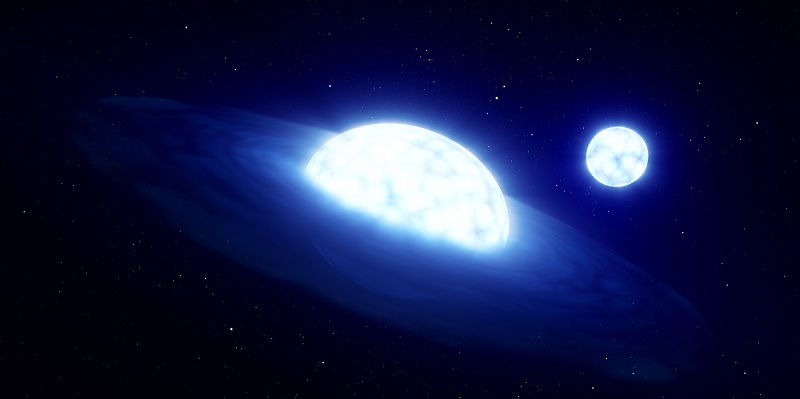
An extreme star system is giving new meaning to the phrase “surf’s up.”
The star system intrigued researchers because it is the most dramatic “heartbeat star” on record. Now new models have revealed that titanic waves, generated by tides, are repeatedly breaking on one of the stars in the system—the first time this phenomenon has ever been seen on a star.
Heartbeat stars are stars in close pairs that periodically pulse in brightness, like the rhythm of a beating heart on an EKG machine. The stars in heartbeat systems loop through elongated oval orbits. Whenever they swing close together, the stars’ gravities generate tides—just as the Moon creates ocean tides on Earth...
G206.93-16.61E2 is close to the reflection nebula NGC 2023 in the Orion B molecular cloud. The Zoom-in pictures show the 1.3mm continuum emission (blue) and CO molecular outflow (orange) of ALMA observation. These observations develop an in-depth understanding of the formation of multiple star systems in the early stage. Â (Image by SHAO) Â
Recently, the international team ALMA Survey of Orion Planck Galactic Cold Clumps (ALMASOP) led by Prof. Liu Tie from Shanghai Astronomical Observatory (SHAO) of the Chinese Academy of Sciences conducted a high-resolution investigation on 72 dense cores in the Orion Giant Molecular Clouds (GMCs) with the Atacama Large Millimeter/submillimeter Array (ALMA), and discovered a forming quadruple-star system within one core...
Patterns in mud cracks show that Mars may have had cyclical moisture patterns. Left: the terrain in the Gale Crater where Curiosity is currently exploring. Right: mud cracks on Earth, where wet-dry cycling has occurred, creating Y-shaped patterns. Credit: Nature (2023). DOI: 10.1038/s41586-023-06220-3
Scientists aren’t entirely sure how life began on Earth, but one prevailing theory posits that persistent cycles of wet and dry conditions on land helped assemble the complex chemical building blocks necessary for microbial life. This is why a patchwork of well-preserved ancient mud cracks found by NASA’s Curiosity Mars rover is so exciting to the mission’s team.
A new paper in Nature details how the distinctive hexagonal pattern of these mud cracks offers the first evidence of wet-d...
Recent Comments