Category Astronomy/Space

Webb Reveals Colors of Earendel, most Distant Star ever Detected

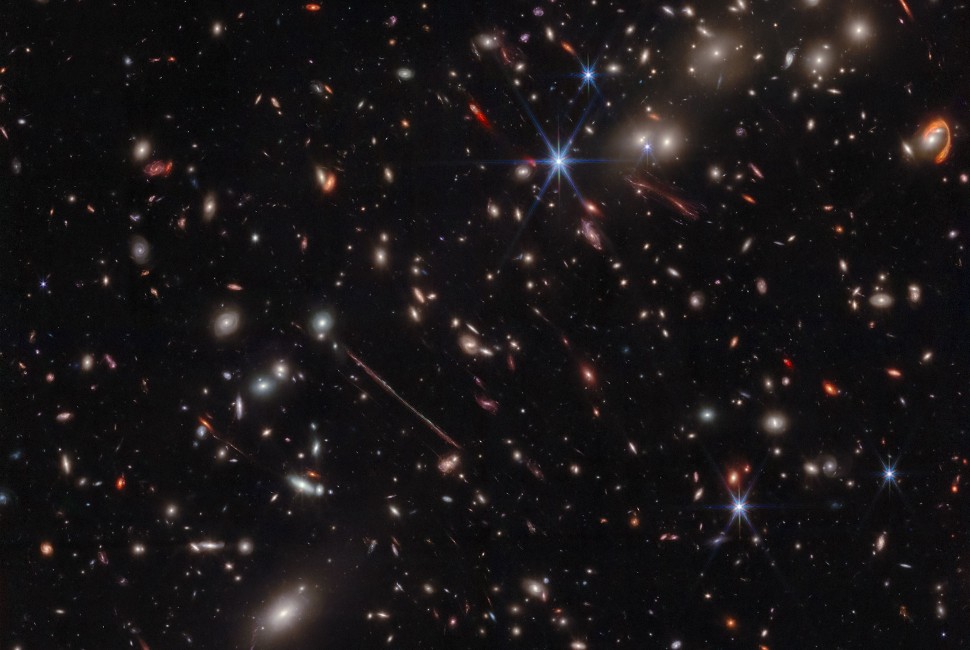
A black background is scattered with hundreds of small galaxies of different shapes, ranging in color from white to yellow to red. Just a bit above the center, there is a bright source of light, a star, with 8 bright diffraction spikes extending out.
This image from NASA’s James Webb Space Telescope of a massive galaxy cluster called WHL0137-08 contains the most strongly magnified galaxy known in the universe’s first billion years: the Sunrise Arc, and within that galaxy, the most distant star ever detected. In this image, the Sunrise Arc appears as a red streak just below the diffraction spike at the 5 o’clock position.
Credits: Image: NASA, ESA, CSA, D. Coe (STScI/AURA for ESA; Johns Hopkins University), B. Welch (NASA’s Goddard Space Flight Center; University of Maryland, College Park). Image processing: Z. Levay.

NASA’s James Webb Space Telescope has followed up on observations by the Hubble Space Telescope of the farthest star ever detected in the very distant universe, within the first billion years after the big bang...

Read More

Hubble Glimpses Globular Cluster NGC 6652

A spherical cluster of stars with a bright core, and stars spread out to the edges gradually giving way to an empty, dark background. A few stars with cross-shaped diffraction spikes appear larger and stand out in front.
Text credit: European Space Agency (ESA)
Image credit: ESA/Hubble & NASA, A. Sarajedini, G. Piotto

The glittering, glitzy contents of the globular cluster NGC 6652 sparkle in this star-studded image from the NASA/ESA Hubble Space Telescope. The core of the cluster is suffused with the pale blue light of countless stars, and a handful of particularly bright foreground stars are adorned with crisscrossing diffraction spikes. NGC 6652 lies in our own Milky Way galaxy in the constellation Sagittarius, just under 30,000 light-years from Earth and only 6,500 light-years from the galactic center.

Globular clusters are stable, tightly gravitationally bound clusters containing anywhere from tens of thousands to millions of stars...

Read More

NASA InSight Study finds Mars is Spinning Faster

NASA’s InSight lander captured this selfie on April 24, 2022, the 1,211th Martian day, or sol, of the mission. Dust on its solar panels caused the lander to lose power in December of that year, but data recorded by InSight’s instruments is still leading to new science.
Credits: NASA/JPL-Caltech

Scientists have made the most precise measurements ever of Mars’s rotation, for the first time detecting how the planet wobbles due to the “sloshing” of its molten metal core. The findings, detailed in a recent Nature paper, rely on data from NASA’s InSight Mars lander, which operated for four years before running out of power during its extended mission in December 2022.

To track the planet’s spin rate, the study’s authors relied on one of InSight’s instruments: a radio transponder and an...

Read More

Gas Streamers Feed Triple Baby Stars

Gas distribution around the trinary protostars IRAS 04239+2436, (left) ALMA observations of SO emissions, and (right) as reproduced by the numerical simulation on the supercomputer ATERUI. In the left panel, protostars A and B, shown in blue, indicate the radio waves from the dust around the protostars. Within protostar A, two unresolved protostars are thought to exist. In the right panel, the locations of the three protostars are shown by the blue crosses. (Credit: ALMA (ESO/NAOJ/NRAO), J.-E. Lee et al.) 

New observations and simulations of three spiral arms of gas feeding material to three protostars forming in a trinary system have clarified the formation of multi-star systems.

Most stars with a mass similar to the Sun form in multi-star systems together with other stars...

Read More