An example of a yellowball (left, circled) and a bubble (right, circled) as seen in infrared images from NASA’s Spitzer Space Telescope. A typical yellowball has a diameter of about a light-year, while a bubble can grow to tens of light-years. This false-color image uses a blue-green-red color scheme to depict infrared wavelengths used in the Milky Way Project and gives rise to the ‘yellow’ color of the feature. Credit: NASA/JPL-Caltech.
A serendipitous discovery by citizen scientists has provided a unique new window into the diverse environments that produce stars and star clusters, revealing the presence of “stellar nurseries” before infant stars emerge from their birth clouds, according to Planetary Science Institute Senior Scientist Grace Wolf-Chase.
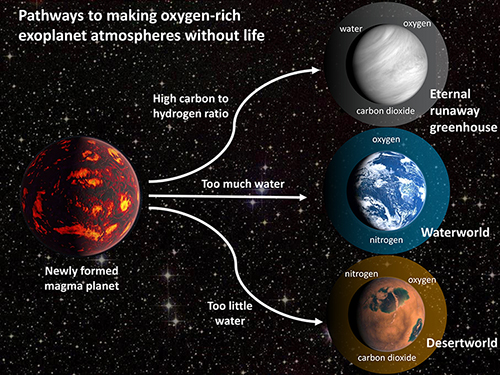
By varying the initial inventory of volatile elements in a model of the geochemical evolution of rocky planets, researchers obtained a wide range of outcomes, including several scenarios in which a lifeless rocky planet around a sun-like star could evolve to have oxygen in its atmosphere. (Illustration by J. Krissansen-Totton)
In the search for life on other planets, the presence of oxygen in a planet’s atmosphere is one potential sign of biological activity that might be detected by future telescopes. A new study, however, describes several scenarios in which a lifeless rocky planet around a sun-like star could evolve to have oxygen in its atmosphere.
The new findings, published April 13 in AGU Advances, highlight the need for next-generation telescopes that are capable of characte...
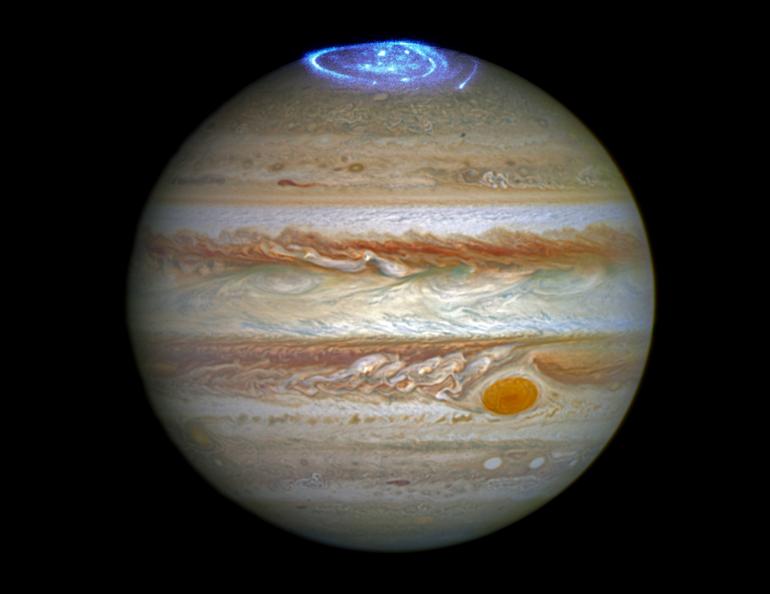
This 2016 image is a composite of two different Hubble observations. The auroras were photographed during a series of Hubble Space Telescope Imaging Spectrograph far-ultraviolet-light observations taking place as NASA’s Juno spacecraft approaches and enters into orbit around Jupiter. Credits: NASA
Jupiter’s polar cap is threaded in part with closed magnetic field lines rather than entirely with open magnetic field lines, new research finds. Auroral displays continue to intrigue scientists, whether the bright lights shine over Earth or over another planet. The lights hold clues to the makeup of a planet’s magnetic field and how that field operates.
New research about Jupiter proves that point — and adds to the intrigue.
Peter Delamere, a professor of space physics at the Universit...
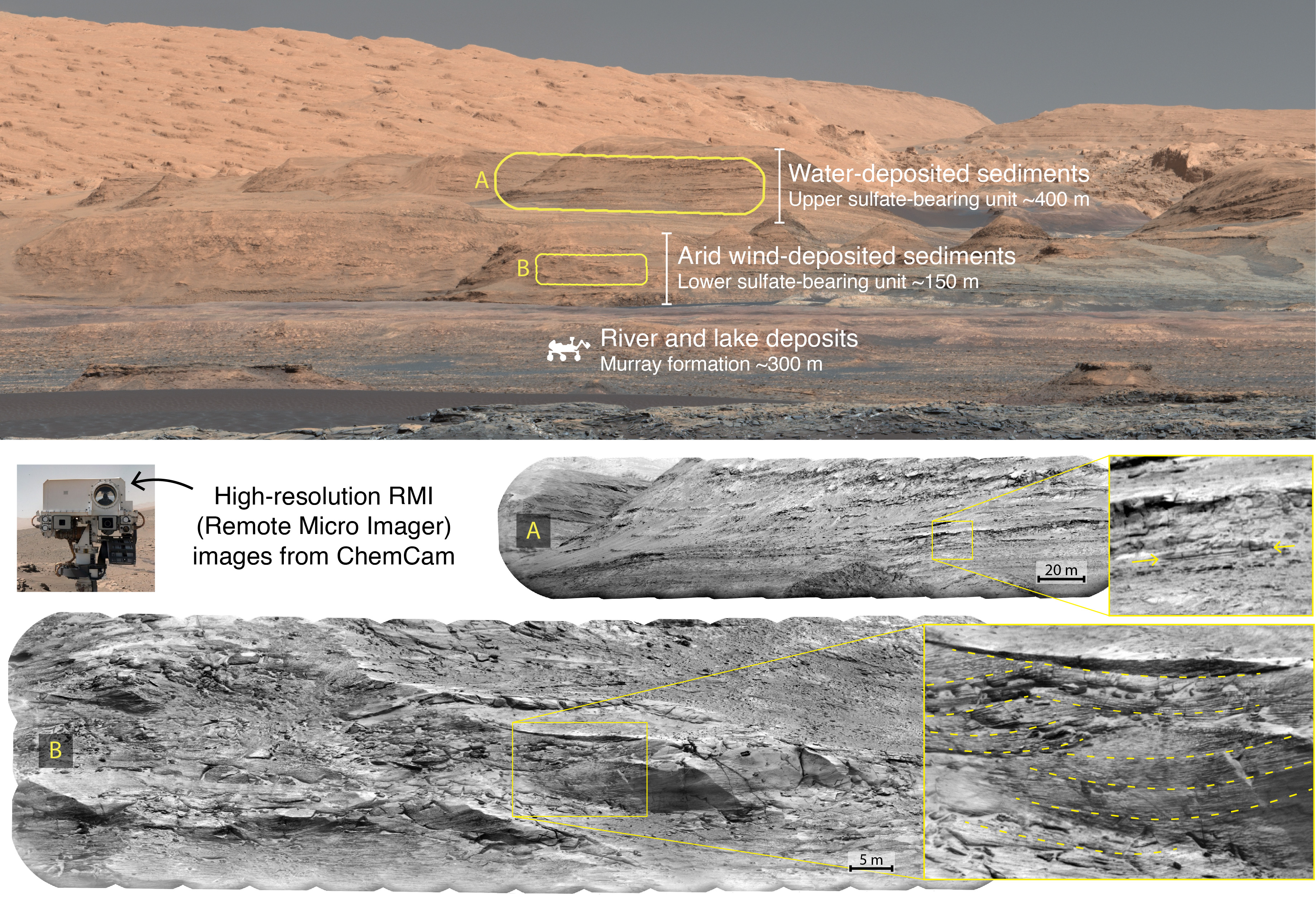
A research team has discovered that the Martian climate alternated between dry and wetter periods, before drying up completely about 3 billion years ago. The Perseverance rover has just landed on Mars. Meanwhile, its precursor Curiosity continues to explore the base of Mount Sharp (officially Aeolis Mons), a mountain several kilometres high at the centre of the Gale crater...





Recent Comments