Category Astronomy/Space

Can a Black Hole Fire up the Cold Heart of the Phoenix Galaxy Cluster?

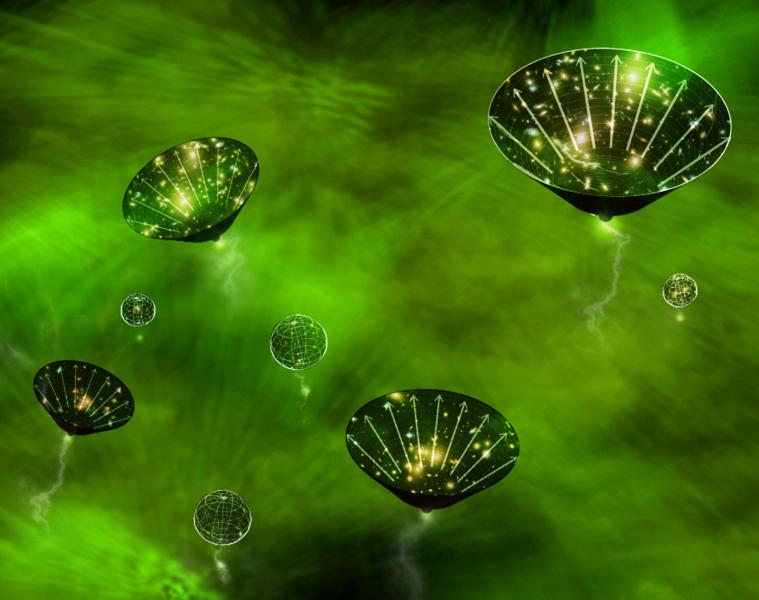
Artist’s illustration of the structures seen in the observations. (Credit: NAOJ) 

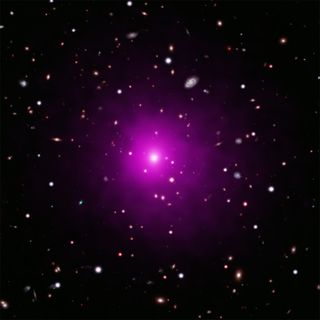
Radio astronomers have detected jets of hot gas blasted out by a black hole in the galaxy at the heart of the Phoenix Galaxy Cluster, located 5.9 billion light-years away in the constellation Phoenix. This is an important result for understanding the coevolution of galaxies, gas, and black holes in galaxy clusters.

Galaxies are not distributed randomly in space. Through mutual gravitational attraction, galaxies gather together to form collections known as clusters. The space between galaxies is not entirely empty. There is very dilute gas throughout a cluster which can be detected by X-ray observations.

If this intra-cluster gas cooled, it would condense under its own gravity to form stars at the ...

Read More

Astrophysics: A direct view of Star/Disk Interactions

Artist’s impression of the streams of hot gas that build up stars. Matter from the surrounding protoplanetary disk, the birthplace of planets, is channeled onto the stellar surface by magnetic fields shocking the surface at supersonic velocity (Copyright: Mark A. Garlick).

A team including researchers from the Institute for Astrophysics of the University of Cologne has for the first time directly observed the columns of matter that build up newborn stars. This was observed in the young star TW Hydrae system located approximately 163 light years from Earth. This result was obtained with the Very Large Telescope Interferometer (VLTI) and its GRAVITY instrument of the European Southern Observatory (ESO) in Chile...

Read More

Rare Encounters between Cosmic Heavyweights

SDSS J141637.44+003352.2, a dual quasar at a distance for which the light reaching us was emitted 4.6 billion years ago. The two quasars are 13,000 light years apart on the sky, placing them near the center of a single massive galaxy that appears to be part of a group, as shown by the neighboring galaxies in the left panel. In the lower panels, optical spectroscopy has revealed broad emission lines associated with each of the two quasars, indicating that the gas is moving at thousands of kilometers per second in the vicinity of two distinct supermassive black holes. The two quasars are different colors, due to different amounts of dust in front of them. Credit: Silverman et al.

Maunakea observatories discover three pairs of merging supermassive blackholes...

Read More

Hubble Maps Giant Halo around Andromeda Galaxy

This illustration shows the location of the 43 quasars scientists used to probe Andromeda’s gaseous halo. These quasars—the very distant, brilliant cores of active galaxies powered by black holes—are scattered far behind the halo, allowing scientists to probe multiple regions. Looking through the immense halo at the quasars’ light, the team observed how this light is absorbed by the halo and how that absorption changes in different regions. By tracing the absorption of light coming from the background quasars, scientists are able to probe the halo’s material.
Credits: NASA, ESA, and E. Wheatley (STScI)

In a landmark study, scientists using NASA’s Hubble Space Telescope have mapped the immense envelope of gas, called a halo, surrounding the Andromeda galaxy, our nearest large g...

Read More