Category Chemistry/Nanotechnology

Solar Hydrogen: Better Photoelectrodes through Flash Heating

Pulsed laser deposition: An intense laser pulse hits a target containing the material, tranforming it into a  plasma which is then deposited as a thin film onto a substrate. © R. Gottesman/HZB

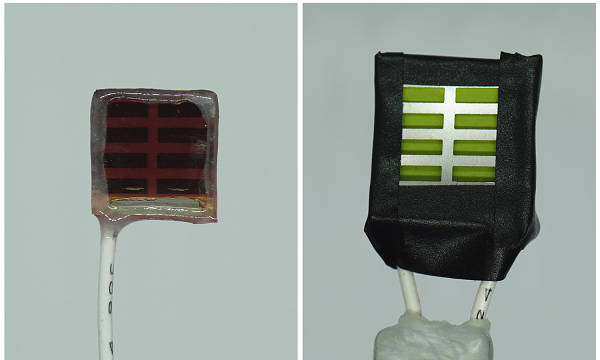
Producing low-cost metal-oxide thin films with high electronic quality for solar water splitting is not an easy task. Especially since quality improvements of the upper metal oxide thin films need thermal processing at high temperatures, which would melt the underlying glass substrate. Now, a team has solved this dilemma: A high intensity and rapid light pulse directly heats the semiconducting metal-oxide thin film, allowing it to reach the optimal temperature without damaging the substrate.

Solar energy can directly drive electrochemical reactions at the surface of photoelectrodes...

Read More

Heat Storage: Scientists develop Material that is Stable, Efficient and Eco-friendly

Felix Marske holds a sample of the new material / Foto: Uni Halle / Marian Sorge

A new heat storage material could help to significantly improve the energy efficiency of buildings. Developed by researchers at Martin Luther University Halle-Wittenberg (MLU) and the University of Leipzig, it can be used to store surplus heat and release it back into the environment when needed. Unlike existing materials, the new one can absorb significantly more heat, is more stable, and is made of harmless substances. In the Journal of Energy Storage the team describes the formation mechanism of the material.

The invention is a so-called shape-stabilized phase change material. It can absorb large amounts of heat by changing its physical state from solid to liquid...

Read More

Scientists shave ‘hairs’ off nanocrystals to improve their electronic properties

University of Chicago graduate student Josh Portner collects x-ray scattering data from tiny “supercrystals.” Scientists hope such supernanocrystals could form the basis of new technologies thanks to a new method to help them talk to one another electronically.
Credit: Talapin lab/University of Chicago

Chemists could yield future devices such as next-gen displays and solar cells. A new study introduces a breakthrough in making nanocrystals function together electronically. The research may open the doors to future devices with new abilities.

You can carry an entire computer in your pocket today because the technological building blocks have been getting smaller and smaller since the 1950s...

Read More

Carbon-Coated Nickel enables a Hydrogen Fuel Cell Free of Precious Metals

Atomic-scale STEM imaging and EELS spectroscopic analysis of core-shell Ni@CNx electrocatalysts. Credit: Proceedings of the National Academy of Sciences (2022). DOI: 10.1073/pnas.2119883119

A nitrogen-doped, carbon-coated nickel anode can catalyze an essential reaction in hydrogen fuel cells at a fraction of the cost of the precious metals currently used, Cornell University researchers have found.

The new discovery could accelerate the widespread use of hydrogen fuel cells, which hold great promise as efficient, clean energy sources for vehicles and other applications.

It’s one of a string of discoveries for the Héctor D. Abruña lab in their ongoing search for active, inexpensive, durable catalysts for use in alkaline fuel cells.

“This finding makes progress toward using eff...

Read More