
Category Physics

New Family of Quasiparticles in Graphene-based Materials

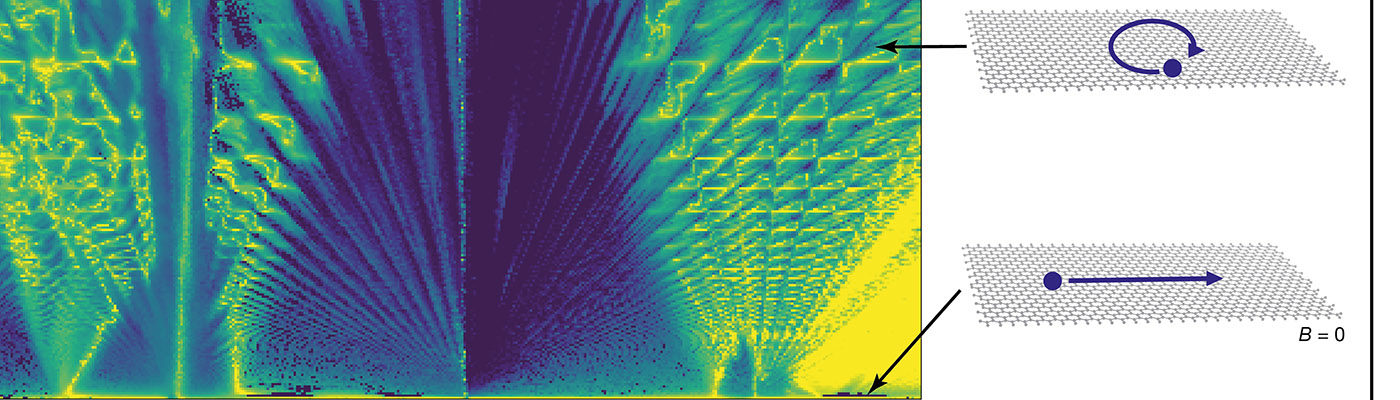
Illustration of BrownZak fermions
Graphene/National Graphene Institute/Manchester group discovers new family of quasiparticles in graphene-based materials

Findings to help achieve Holy Grail of 2D materials – superfast electronic devices. A group of researchers led by Sir Andre Geim and Dr Alexey Berdyugin at The University of Manchester have discovered and characterised a new family of quasiparticles named ‘Brown-Zak fermions’ in graphene-based superlattices.

The team achieved this breakthrough by aligning the atomic lattice of a graphene layer to that of an insulating boron nitride sheet, dramatically changing the properties of the graphene sheet.

The study follows years of successive advances in graphene-boron nitride superlattices which allowed the observation of a fractal pattern known as the Hofstadter’s bu...

Read More


System brings Deep Learning to ‘IoT’ devices

Iot devices
MIT researchers have developed a system, called MCUNet, that brings machine learning to microcontrollers. The advance could enhance the function and security of devices connected to the Internet of Things (IoT).

Advance could enable AI on household appliances while enhancing data security and energy efficiency. A new system brings machine learning to microcontrollers. The advance could enhance the function and security of devices connected to the Internet of Things (IoT).

Deep learning is everywhere. This branch of artificial intelligence curates your social media and serves your Google search results. Soon, deep learning could also check your vitals or set your thermostat...

Read More

Making 3D Nanosuperconductors with DNA

illustration
An illustration showing how highly nanostructured 3-D superconducting materials can be created based on DNA self-assembly.An illustration showing how highly nanostructured 3-D superconducting materials can be created based on DNA self-assembly.

A platform for making 3D superconducting nano-architectures with a prescribed organization could find application in quantum computing and sensing.

3-D nanostructured materials — those with complex shapes at a size scale of billionths of a meter — that can conduct electricity without resistance could be used in a range of quantum devices...

Read More

Researchers 3D print Biomedical Parts with Supersonic Speed

Cells adhering to titanium alloy
This image shows cells adhering to a titanium alloy created by cold-spray 3D printing, which demonstrates the material’s biocompatibility.

Forget glue, screws, heat or other traditional bonding methods. A Cornell University-led collaboration has developed a 3D printing technique that creates cellular metallic materials by smashing together powder particles at supersonic speed.

This form of technology, known as “cold spray,” results in mechanically robust, porous structures that are 40% stronger than similar materials made with conventional manufacturing processes. The structures’ small size and porosity make them particularly well-suited for building biomedical components, like replacement joints.

The team’s paper, “Solid-State Additive Manufacturing of Porous Ti-6Al-4V by Supe...

Read More