
Category Physics

As seen in Movies, new Meta-Hologram can be used as a Communication Tool

Meta-hologram optical device that operated in forward and backward directions.
CREDIT
Junsuk Rho(POSTECH)

Scientists have developed a multiplexed meta-hologram device operating at visible light. The newly developed technique can transmit information to multiple users from different locations. This can be employed in many hologram applications such as performance, exhibitions, automobiles and more.

Hologram techniques are already used in our everyday life. A hologram sticker to prevent from counterfeiting money, Augmented Reality navigation projected in front mirror of a car to guide directions, and Virtual Reality game that allows a user to play in a virtual world with a feeling of live are just a few examples to mention...

Read More
On the way to Quantum Networks

Picture of the single atom trap. In the ultra-high vacuum glass cell a single Rubidium atom is captured, which later will be entangled with a photon. Photo: C. Olesinski/LMU

Physicists at LMU, together with colleagues at Saarland University, have successfully demonstrated the transport of an entangled state between an atom and a photon via an optic fiber over a distance of up to 20 km – thus setting a new record.

‘Entanglement’ describes a very particular type of quantum state which is not attributed to a single particle alone, but which is shared between two different particles. It irrevocably links their subsequent fates together – no matter how far apart they are – which famously led Albert Einstein to call the phenomenon as “spooky action at a distance”...

Read More

Well-designed Substrates make Large Single Crystal Bi-/Tri-Layer Graphene Possible

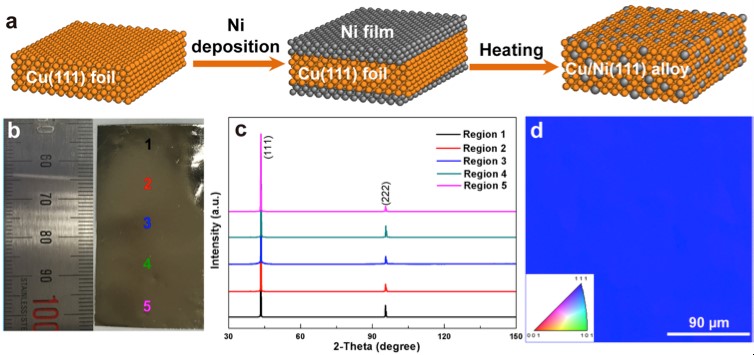
Figure 1. Preparation and characterization of Cu/Ni(111) foils.
Preparation and characterization of Cu/Ni(111) foils. (a) Schematic of the preparation of the Cu/Ni(111) foils shows that Ni films are electroplated on both sides of a Cu(111) foil, which is followed by heating in a chemical vapor deposition chamber at 1050 oC for 5-7 hours to obtain the Cu/Ni(111) foil. By controlling the concentration of nickel (Ni), IBS researchers could obtain bilayer and trilayer graphene with the desired stacking order and large area. (b) A photograph of a piece of Cu/Ni(111) alloy foil (3 cm × 5 cm in size). (c) X-ray pattern taken from different regions across the whole sample (3 cm × 5 cm). (d) Electron backscatter diffraction map indicating the uniform (111) orientation of the prepared Cu foils.

IBS researchers fabricate single crystal copper nickel alloy...

Read More

Ingestible Medical Devices can be Broken Down with Light

MIT engineers demonstrated a bariatric balloon that can be inflated in the stomach and then degraded by shining light on the seal, which is made of a novel light-sensitive polymer.
Image: Ritu Raman

New light-sensitive material could eliminate some of the endoscopic procedures needed to remove gastrointestinal devices

A variety of medical devices can be inserted into the gastrointestinal tract to treat, diagnose, or monitor GI disorders. Many of these have to be removed by endoscopic surgery once their job is done. However, MIT engineers have now come up with a way to trigger such devices to break down inside the body when they are exposed to light from an ingestible LED.

The new approach is based on a light-sensitive hydrogel that the researchers designed...

Read More