To raise new questions, new possibilities, to regard old problems from a new angle, requires creative imagination and marks real advance in science.
~Albert Einstein
Read More
Old Newtonian physics claimed that things have an objective reality separate from our perception of them. Quantum physics, and particularly Heisenberg's Uncertainty Principle, reveal that, as our perception of an object changes, the object itself literally changes.
~Marianne Williamson
Read More
In the opto-spintronic nanostructure, an electron spin polarisation degree greater than 90% is achieved at room temperature in a quantum dot, via remote defect-enabled spin filtering through an adjacent layer of gallium nitrogen arsenide (GaNAs). When such a spin polarised electron recombines, it emits chiral light. The spin state of the electron determines whether the electromagnetic field of the light will rotate clockwise or anticlockwise around the direction of travel. Yuqing Huang
It may be possible in the future to use information technology where electron spin is used to store, process and transfer information in quantum computers. It has long been the goal of scientists to be able to use spin-based quantum information technology at room temperature...
Exoplanet HD 209458b transits its star. The illuminated crescent and its colours have been exaggerated to illustrate the light spectra that the astronomers used to identify the six molecules in its atmosphere.
Astronomers have found evidence that the first exoplanet that was identified transiting its star could have migrated to a close orbit with its star from its original birthplace further away.
Analysis of the planet’s atmosphere by a team including University of Warwick scientists has identified the chemical fingerprint of a planet that formed much further away from its sun than it currently resides...
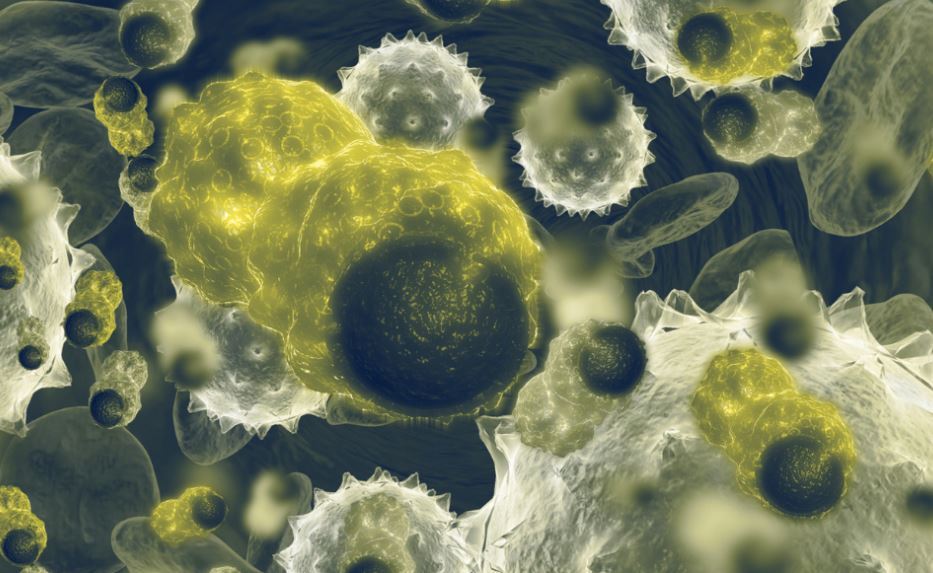
Scientists detail new work on NLRP3, an intracellular complex that has been found to participate in melanoma-mediated inflammation, leading to tumor growth and progression. By inhibiting NLRP3, the researchers found, they can reduce inflammation and the resultant tumor expansion.
Cancer doctors may soon have a new tool for treating melanoma and other types of cancer, thanks to work being done by researchers at the University of Colorado Cancer Center.
Specifically, NLRP3 promotes inflammation by inducing the maturation and release of interleukin-1-beta, a cytokine that causes inflammation as part of the normal immune response to infection. In cancer, however, inflammation can cause tumors to grow and spread.
“NLRP3 is a member of a larger family that is involved in sensing da...
Anshumali Shrivastava is an assistant professor of computer science at Rice University. Credit: Jeff Fitlow/Rice University
Rice University computer scientists have demonstrated artificial intelligence (AI) software that runs on commodity processors and trains deep neural networks 15 times faster than platforms based on graphics processors.
“The cost of training is the actual bottleneck in AI,” said Anshumali Shrivastava, an assistant professor of computer science at Rice’s Brown School of Engineering. “Companies are spending millions of dollars a week just to train and fine-tune their AI workloads.”
Shrivastava and collaborators from Rice and Intel will present research that addresses that bottleneck April 8 at the machine learning systems conference MLSys.













Recent Comments