Medical Robotic Hand? Rubbery Semiconductor makes it possible

Yu Robotic Hand
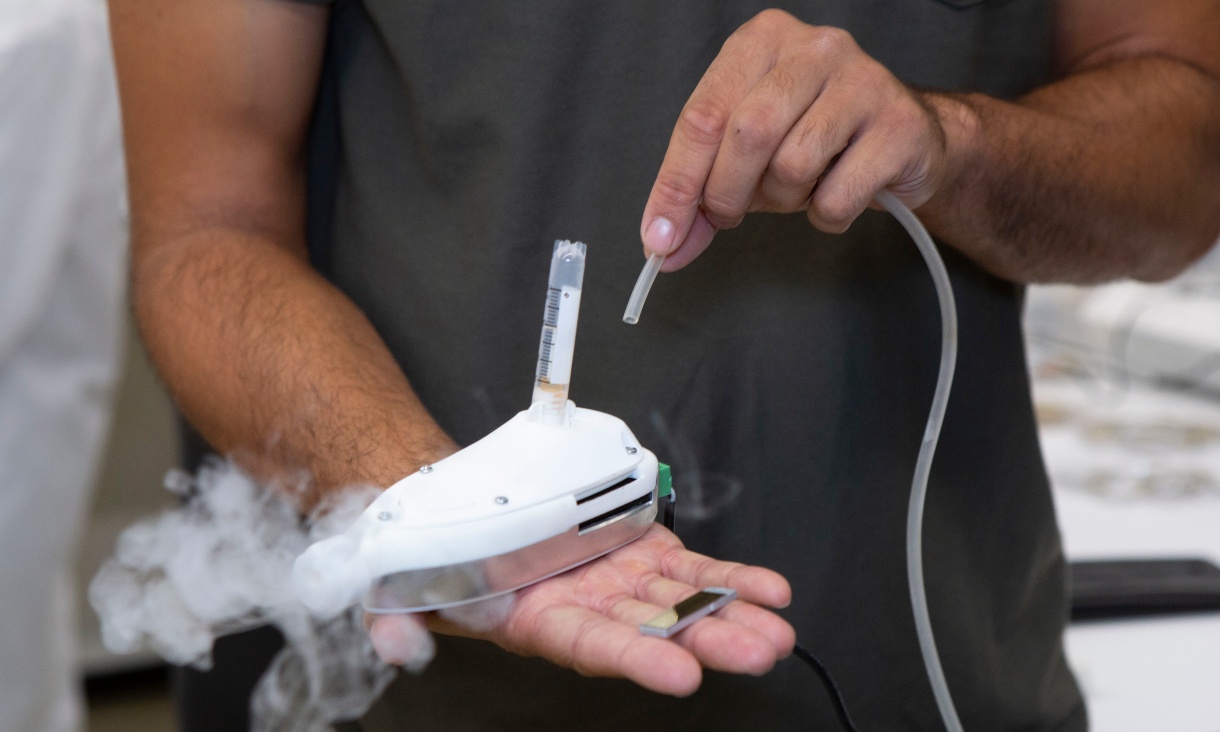
A medical robotic hand is just one potential application for the rubbery electronics reported by researchers.

Rubbery electronics offer promise for new applications. A medical robotic hand could allow doctors to more accurately diagnose and treat people from halfway around the world, but currently available technologies aren’t good enough to match the in-person experience.

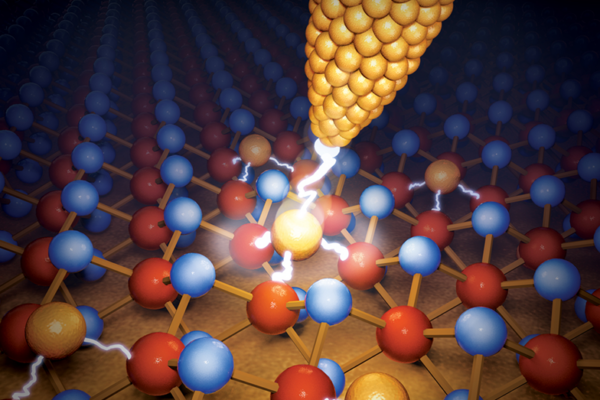
Researchers report in Science Advances that they have designed and produced a smart electronic skin and a medical robotic hand capable of assessing vital diagnostic data by using a newly invented rubbery semiconductor with high carrier mobility.

Cunjiang Yu, Bill D...

Read More

COVID-19 virus uses Heparan Sulfate to get inside cells

SARS-CoV-2’s spike protein must bind both the ACE2 receptor and heparan sulfate to gain entry into human cells

Discovery opens new possibilities for treating COVID-19 by disrupting virus’ ability to bind the carbohydrate, potentially by using a repurposed drug. Researchers discovered that the SARS-CoV-2 virus can’t grab hold of cell receptor ACE2 without a carbohydrate called heparan sulfate, which is also found on lung cell surfaces – disrupting that interaction with a repurposed drug may help treat COVID-19.

A molecule known as ACE2 sits like a doorknob on the outer surfaces of the cells that line the lungs...

Read More

NextGen Organoids Grow and Function like Real Tissues

Next-gen organoids grow and function like real tissues
Fluorescence image of a mini-gut with characteristic crypts containing labeled stem cells (red). Credit: M. Nikolaev, Lutolf Lab (EPFL)

Bioengineers have created miniature intestines in a dish that match up anatomically and functionally to the real thing better than any other lab-grown tissue models. The biological complexity and longevity of the new organoid technology is an important step towards enabling drug testing, personalized medicine, and perhaps, one day, transplantations.

Organoids are fast-becoming one of the most cutting-edge tools of modern life sciences. The idea is to use stem cells to build miniature tissues and organs that accurately resemble and behave like their real counterparts.

One can immediately appreciate the value of organoids for both research and medi...

Read More

Can life Survive a Star’s Death? Webb Telescope can reveal the answer

A planet orbiting a small star produces strong atmospheric signals when it passes in front, or ‘transits,’ its host star, as pictured above. White dwarfs offer astronomers a rare opportunity to characterize rocky planets. Credit: Carl Sagan Institute

When stars like our sun die, all that remains is an exposed core—a white dwarf. A planet orbiting a white dwarf presents a promising opportunity to determine if life can survive the death of its star, according to Cornell University researchers.

In a study published in the Astrophysical Journal Letters, they show how NASA’s upcoming James Webb Space Telescope could find signatures of life on Earth-like planets orbiting white dwarfs.

A planet orbiting a small star produces strong atmospheric signals when it passes in front, or “tran...

Read More