To raise new questions, new possibilities, to regard old problems from a new angle, requires creative imagination and marks real advance in science.
~Albert Einstein
Read More
Old Newtonian physics claimed that things have an objective reality separate from our perception of them. Quantum physics, and particularly Heisenberg's Uncertainty Principle, reveal that, as our perception of an object changes, the object itself literally changes.
~Marianne Williamson
Read More
Temperate exoplanet LHS 1140 b may be a world completely covered in ice (left) similar to Jupiter’s moon Europa or be an ice world with a liquid substellar ocean and a cloudy atmosphere (centre). LHS 1140 b is 1.7 times the size of our planet Earth (right) and is the most promising habitable zone exoplanet yet in our search for liquid water beyond the Solar System. Image credit: B. Gougeon/Université de Montréal
A team of astronomers has identified a temperate exoplanet as a promising super-Earth ice or water world.
The findings, led by Université de Montréal, show that the habitable zone exoplanet, LHS 1140 b, is not likely a mini-Neptune, a small so-called gas giant—large planets composed mostly of gas—with a thick hydrogen-rich atmosphere...
A newly developed method called ReapTEC allowed the discovery of thousands of active bidirectional enhancers. Further analysis of GWAS data revealed that various immune-mediated diseases, like multiple sclerosis and rheumatoid arthritis, are related to genetic variations within these enhancers.
Researchers led by Yasuhiro Murakawa at the RIKEN Center for Integrative Medical Sciences (IMS) and Kyoto University in Japan and IFOM ETS in Italy have discovered several rare types of helper T cells that are associated with immune disorders such as multiple sclerosis, rheumatoid arthritis, and even asthma...
A research team led by Prof. Eric Cheng, Professor of the Department of Electrical and Electronic Engineering at PolyU has developed a novel freezer truck that supports a solar-powered freezer system and features vehicle-connected power storage and sharing technology.
The transport sector is a significant contributor to greenhouse gas emissions in Hong Kong, accounting for 19% of total emissions. Supporting the development of green transport can help reduce air pollutant emissions. The Hong Kong Polytechnic University (PolyU) is committed to promoting research into green technologies to support Hong Kong’s goal of reducing the City’s total carbon emissions from the 2005 level by half before 2035 and achieving carbon neutrality before 2050.
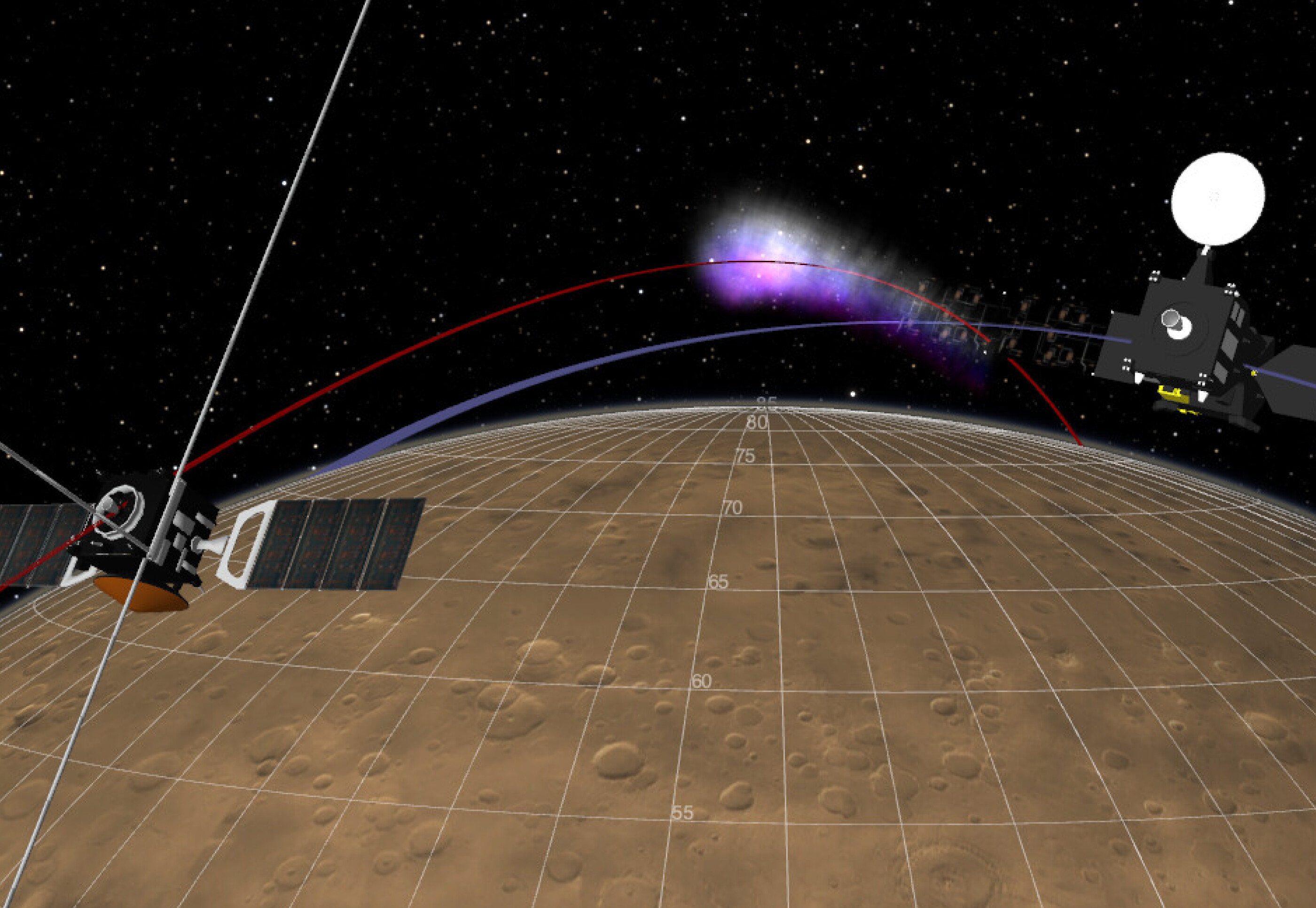
Using the repurposed equipment, a team including Imperial College London researchers have measured parts of the Martian atmosphere that were previously impossible to probe. This includes areas that can block radio signals if not properly accounted for—crucial for future Mars habitation missions.
The results of the first 83 measurements, analyzed by Imperial researchers and European Space Agency (ESA) colleagues across Europe, are published today in the journal Radio Science.
To achieve this, ExoMars’ Trace Gas Orbiter (TGO) teamed up with another ESA spacecraft orbiting the red planet: Mars Express (MEX). The two craft maintain a radio link, so that as one passes behind the planet, radio waves cut through the deeper layers of the Martian atmosphere.













Recent Comments