Researchers Generate High-Quality Quantum Light with Modular Waveguide Device

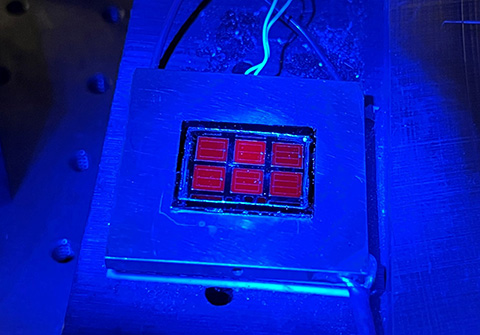
 Researchers developed a new waveguide optical parametric amplifier (OPA) module (pictured), which they combined with a specially designed photon detector to generate strongly nonclassical light that can be used for quantum experiments.
Image Credit: Kan Takase, University of Tokyo

New approach could enable faster and more practical optical quantum computers. For the first time, researchers have successfully generated strongly nonclassical light using a modular waveguide-based light source. “Our goal is to dramatically improve information processing by developing faster quantum computers that can perform any type of computation without errors,” said research team member Kan Takase from the University of Tokyo...

Read More

Breakthrough Measurement Elucidates Neutrino Interactions

A close-up view of a muon neutrino argon interaction within an event display at MicroBooNE, one out of 11,528 events used to extract energy-dependent muon neutrino argon interaction cross sections.

Physicists studying ghost-like particles called neutrinos from the international MicroBooNE collaboration have reported a first-of-its-kind measurement: a comprehensive set of the energy-dependent neutrino-argon interaction cross sections. This measurement marks an important step towards achieving the scientific goals of next-generation of neutrino experiments — namely, the Deep Underground Neutrino Experiment (DUNE).

Neutrinos are tiny subatomic particles that are both famously elusive and tremendously abundant...

Read More

Researchers Identify Potential New Treatment for Metabolic Syndrome

Highlights
Protein tyrosine phosphatase receptor δ is the orexigenic asprosin receptor
Ptprd loss results in appetite reduction and unresponsiveness to exogenous asprosin
AgRP neuron-specific Ptprd ablation leads to protection from diet-induced obesity
The Ptprd ligand-binding domain functions as an appetite-suppressing therapeutic

Metabolic syndrome increases a person’s risk for diabetes, heart disease, and stroke, and includes conditions such as obesity, high blood pressure and high blood sugar...

Read More

Differences between the Moon’s Near and Far Sides linked to Colossal Ancient Impact

New research shows how the impact that created the Moon’s South Pole – Aitken basin is linked to the stark contrast in composition and appearance between the two sides of the Moon.

The face that the Moon shows to Earth looks far different from the one it hides on its far side. The nearside is dominated by the lunar mare – the vast, dark-colored remnants of ancient lava flows. The crater-pocked farside, on the other hand, is virtually devoid of large-scale mare features. Why the two sides are so different is one of the Moon’s most enduring mysteries.

Now, researchers have a new explanation for the two-faced Moon – one that relates to a giant impact billions of years ago near the Moon’s south pole.

A new study published in the journal Science Advances shows that the impact that...

Read More