



Neuromorphic computing is a computing approach that mimics how the human brain works. Our gray matter is a marvel of nature, capable of handling huge volumes of data with incredible energy efficiency. While modern AI hardware is becoming better at processing complex tasks, it consumes vast amounts of energy.
One of the promises of neuromorphic computing is that it places memory and processing in the same location, using far less energy than traditional AI chips. However, even the most sophisticated neuromorphic systems are fairly simple and don’t come close to matching the number of connections among human neurons.
But a new study published in the journal Science Advances suggests that by using sound waves instead of electricity, hardware can better mimic the parallel processing of neurons with even greater efficiency.
Nature does it better
Researchers from the University of Arizona developed a new approach to processing information, taking their cue from nature, particularly the brain’s synapses. These are the connections between neurons.
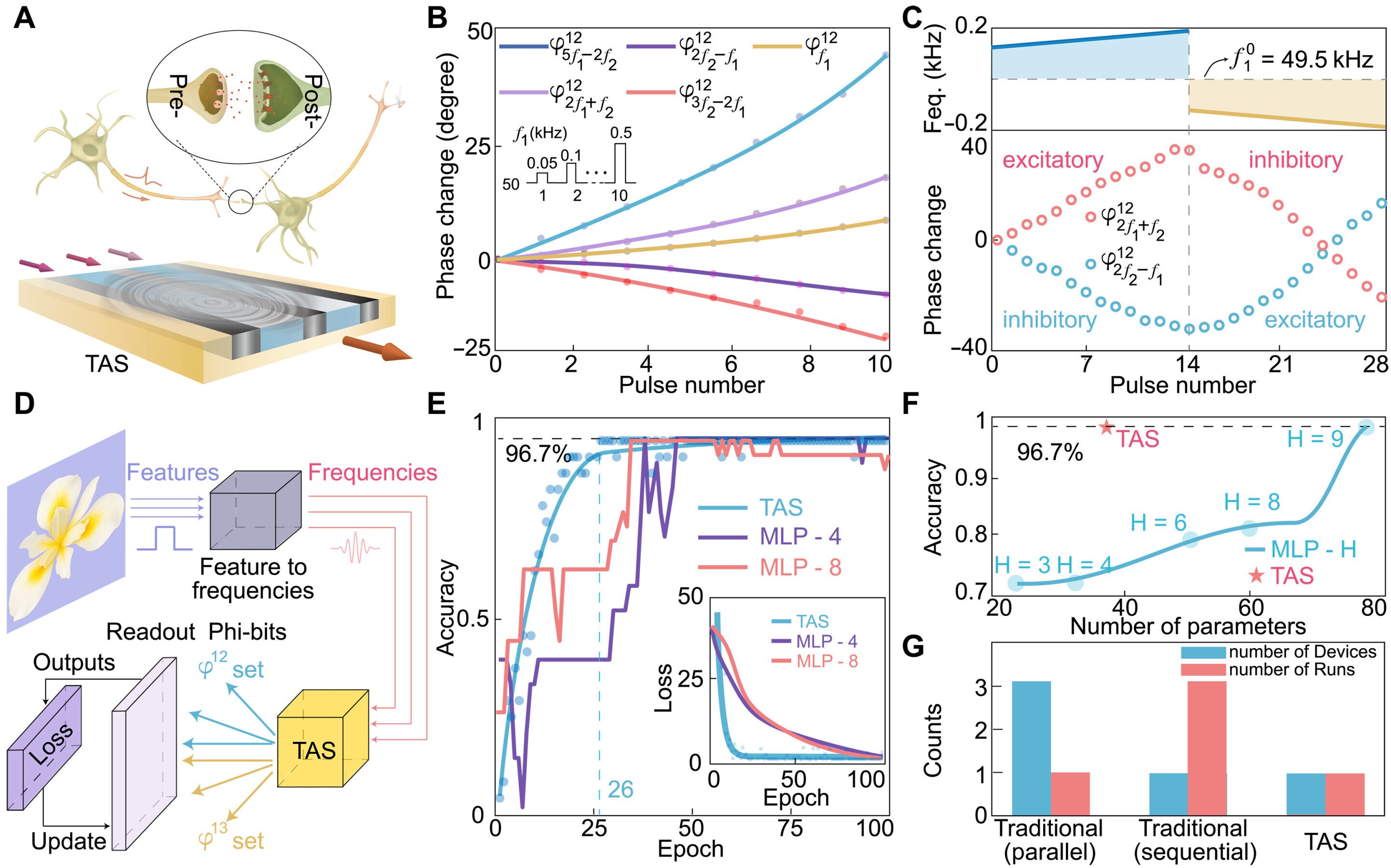
Their device is called a topological acoustic synapse. Instead of relying on electrons to move through microscopic wires, as happens in traditional silicon chips, this technology sends acoustic waves through tiny, connected pathways.
Much like a biological synapse that changes its connection strength to pass information along, this device can amplify or dampen sound waves as they travel. This information is encoded in the timing differences between the overlapping waves.
The team tested their system on a series of everyday computer challenges, like sorting flower species and recognizing handwritten digits. It performed extremely well, learning faster than standard neural network models and producing highly accurate results. It also required fewer internal adjustments to complete the tasks.
What’s more, the system operated at much lower power levels than two prominent types of state-of-the-art electrical hardware. These were field-effect transistors (FETs) and memristors.
“Here, we introduce the topological acoustic synapse (TAS), an acoustic-wave neuromorphic device that circumvents these limits by mapping information in multivariate state spaces,” the research team commented in its paper.
“In conclusion, we have harnessed nonlinear acoustic wave dynamics in coupled waveguides to realize TAS.”
Could sound chips be the future?
The research demonstrated that a single acoustic synapse can handle multiple data streams simultaneously and efficiently. The long-term goal is to scale up by operating several of these synapses at once. By integrating numerous components into tiny, chip-like structures, the team hopes to create ultra-efficient hardware that functions like the human brain and handles advanced computing tasks. https://techxplore.com/news/2026-06-power-kind-chip-human-brain.html



Recent Comments