



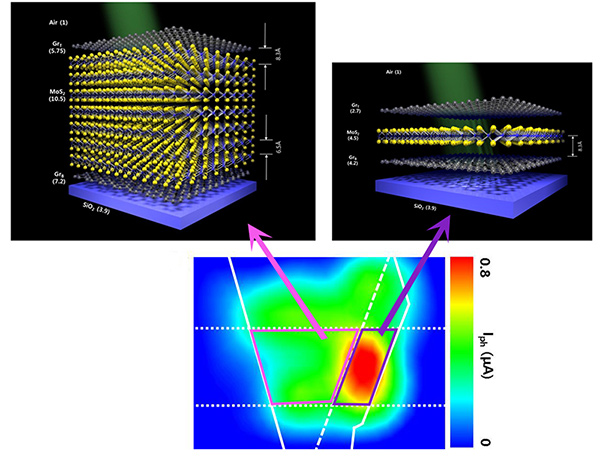
(top) Devices with one-layer and seven-layer MoS2 were built on top of a silicon base and compared. Dielectric constants responsible for the difference in electrostatic potentials are shown in parenthesis. (bottom) The device with one-layer MoS2 (inside the violet box) showed better performance in converting light to electric current than the seven-layer device (inside the pink box).
The Center for Integrated Nanostructure Physics, within the Institute for Basic Science (IBS) has developed the world’s thinnest photodetector, that is a device that converts light into an electric current. With a thickness of just 1.3nm – 10X smaller than the current standard silicon diodes – this device could be used in the Internet of Things IoT, smart devices, wearable electronics and photoelectronics.
In order to increase graphene’s usability, IBS scientists sandwiched a layer of the 2D semiconductor MoS2 between two graphene sheets and put it over a silicon base. They initially thought the resulting device was too thin to generate an electric current but, unexpectedly, it did. “A device with one-layer of MoS2 is too thin to generate a conventional p-n junction, where positive (p) charges and negative (n) charges are separated and can create an internal electric field. However, when we shine light on it, we observed high photocurrent. It was surprising! Since it cannot be a classical p-n junction, we thought to investigate it further,” explains YU Woo Jong.
The researchers compared devices with 1 and 7 layers of MoS2 and tested how well they behave as a photodetector, that is, how they are able to convert light into an electric current. They found that the device with 1-layer MoS2 absorbs less light than the device with 7 layers, but it has higher photoresponsitivity. “Usually the photocurrent is proportional to the photoabsorbance, that is, if the device absorbs more light, it should generate more electricity, but in this case, even if the one-layer MoS2 device has smaller absorbance than the seven-layer MoS2, it produces 7 times more photocurrent,” describes Yu.
The monolayer is thinner and therefore more sensitive to the surrounding environment: The bottom SiO2 layer increases the energy barrier, while the air on top reduces it, thus electrons in the monolayer device have a higher probability to tunnel from the MoS2 layer to the top graphene (GrT). The energy barrier at the GrT/MoS2 junction is lower than the one at the GrB/MoS2, so the excited electrons transfer preferentially to the GrT layer and create an electric current. Conversely, in the multi-layer MoS2 device, the energy barriers between GrT/MoS2 and GrB/MoS2 are symmetric, therefore the electrons have the same probability to go either side and thus reduce the generated current.
Although electron tunneling and walking a tunnel in a mountain are very different of course, the idea is that electric current is generated by the flow of electrons, and the thinner device can generate more current because more electrons flow towards the same direction. Actually, when light is absorbed by the device and MoS2 electrons jump into an excited state, they leave the so-called holes behind. Holes behave like positive mobile charges and are essentially positions left empty by electrons that absorbed enough energy to jump to a higher energy status. Another problem of the thicker device is that electrons and holes move too slowly through the junctions between graphene and MoS2, leading to their undesired recombination within the MoS2 layer.
For these reasons, up to 65% of photons absorbed by the thinner device are used to generate a current. Instead, the same measurement (quantum efficiency) is only 7% for the seven-layer MoS2 apparatus. “This device is transparent, flexible and requires less power than the current 3D silicon semiconductors. If future research is successful, it will accelerate the development of 2D photoelectric devices,” explains the professor. https://www.ibs.re.kr/cop/bbs/BBSMSTR_000000000738/selectBoardArticle.do?nttId=13809&pageIndex=1&searchCnd=&searchWrd=


Recent Comments