



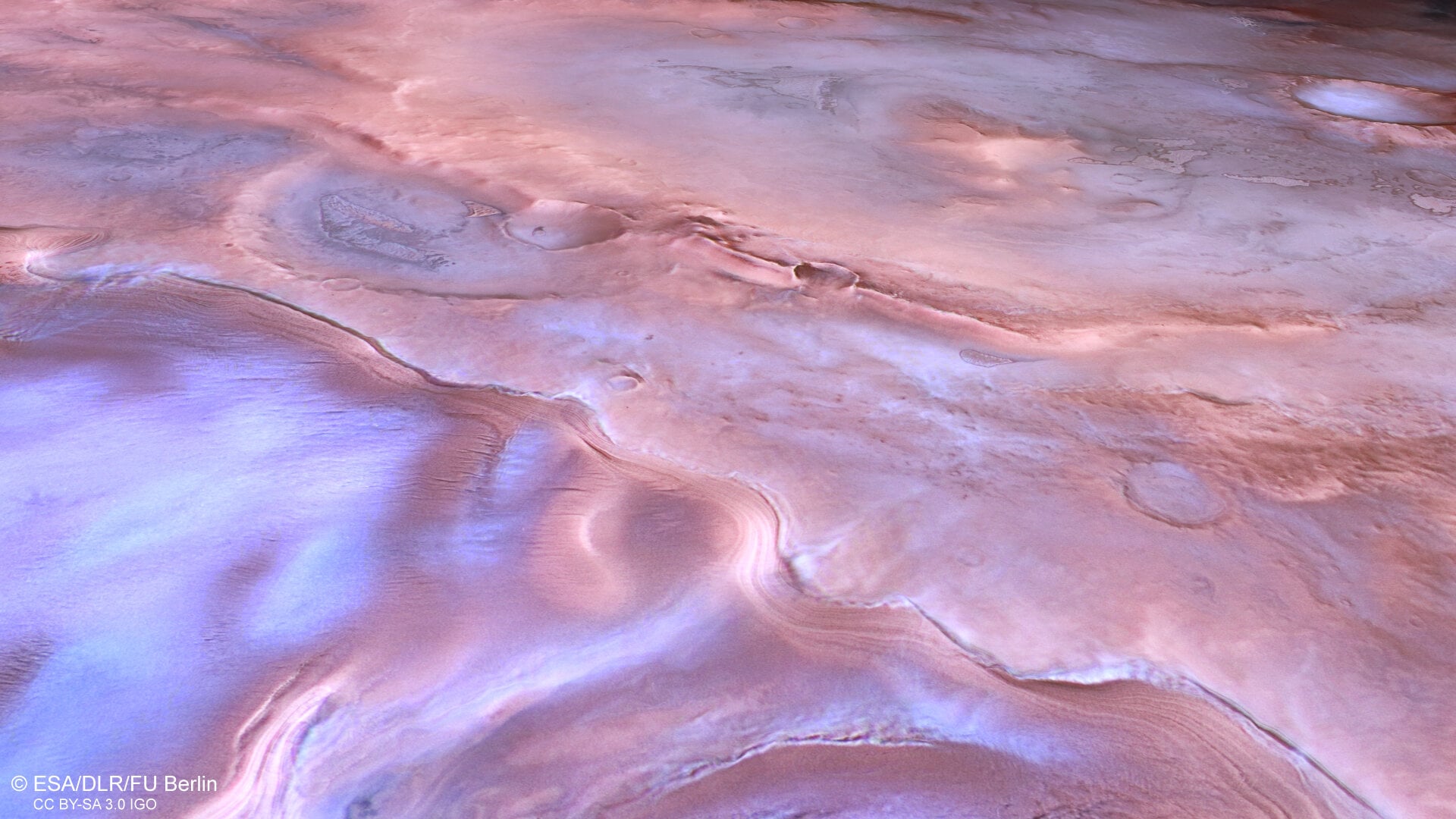
Oxidized iron dominates the Martian color palette. The dusty reds, ochers, browns and tans give the planet its nickname: the Red Planet. But new images of Mars’ south polar region show something different. Swirls of pink, purple and red highlight the region and a feature named Thyles Rupes, an icy crag with cliffs higher than 1 km (0.6 miles). Rupes means cliff in Latin, while Thyles is a mythical northern land spoken of in the ancient world.
All the differently colored materials in this region have different sources. Volcanoes created and spread the darker material, which is rich in minerals like olivine and pyroxene, both of which are also plentiful in Earth’s mantle. Olivine is made of magnesium, iron and silicate. Pyroxenes are a group of silicate minerals made mostly of silicon and oxygen, also common in Earth’s upper mantle.
The pale bluish areas, like those in the crater, are covered in frozen carbon dioxide. Near the south pole, this material persists even in springtime, when this image was captured. The pale patch on the lower left is part of the south polar cap. The main cap never melts, but a seasonal CO2 frost cap expands and contracts with the seasons.
The region’s overall blueberry-purple hue comes from a combination of dust and frost. But the region doesn’t always look like this; it changes throughout the day. Dust in the air, soft morning light, frost covering the ground, and patches of ice and dust mixed together combine to create the purplish scene.
Different types of dunes are also visible in the image. Because of mixed wind patterns, there are no finely sculpted dunes like the ones found elsewhere on Mars. There are even what are called barchanoid ridges, arc-shaped dunes common in Earth’s sandy deserts that have two downwind-facing “horns.”
Thyles Rupes, which extends for hundreds of kilometers, formed in a similar way to mountains on Earth, when two plates push against one another. On Earth, tectonic plate movement is ongoing, forming new mountains on geological timescales. But not on Mars; it has no tectonics. It’s a single-plate, stagnant-lid planet. So Thyles Rupes most likely formed when the planet’s interior was cooling. As the crust contracted, some parts were thrust upward.
Orbiters like Mars Express, with powerful cameras, have opened a window onto the Martian surface. Over the last couple of decades, Mars Express (and NASA’s Mars Reconnaissance Orbiter) have delivered a steady stream of images of the planet’s various regions. Though the planet may be dead, its surface is still intriguing and holds many lessons about how different rocky planets can be. https://www.universetoday.com/articles/the-red-planet-has-a-purple-side



Recent Comments